
The limit on how much fuel you can use is not your stomach and not your legs. It is a transport protein in your intestinal wall, and it has a number.

How many carbohydrates can you absorb per hour?
Around 60 g per hour from a single carbohydrate source, and up to roughly 90 g per hour when you combine glucose and fructose. Past that ceiling the extra carbohydrate sits in your intestine rather than reaching your muscles.
Why 60 grams is a hard wall
Glucose crosses your intestinal wall through a transporter called SGLT1. Jeukendrup's work established that SGLT1 saturates at approximately 60 g of carbohydrate an hour. Past that point extra glucose does not move faster. It stays in the intestine, draws water in by osmosis, and ferments.
This is why doubling your gels does not double your fuel. You are queuing at a door that is already full.
How the ceiling gets raised
Fructose does not use SGLT1. It crosses via GLUT5, a separate route. Feed both at once and you open two doors instead of one.
Combined intake raises exogenous carbohydrate oxidation to around 90 g/h at a 2:1 glucose to fructose ratio. Later work by O'Brien and Rowlands found a ratio nearer 1:0.8 pushes efficiency higher again, close to 102 g/h, with lower reported gut discomfort at high intensity. Podlogar and Wallis have since examined intakes of 120 g/h.
For most athletes the working range is 60 to 90 g/h. Above that you are in territory that needs deliberate gut training and a product built for it.
What should I actually target?
| Effort | Carbohydrate target |
|---|---|
| Under 75 minutes | Little to none required |
| 75 minutes to 2.5 hours | 30 to 60 g/h |
| 2.5 hours and beyond | 60 to 90 g/h |
| Ironman, ultra, grand tour stage | 90 g/h and up, gut-trained |
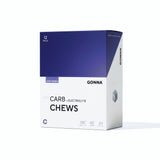
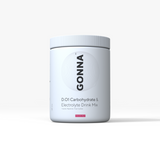
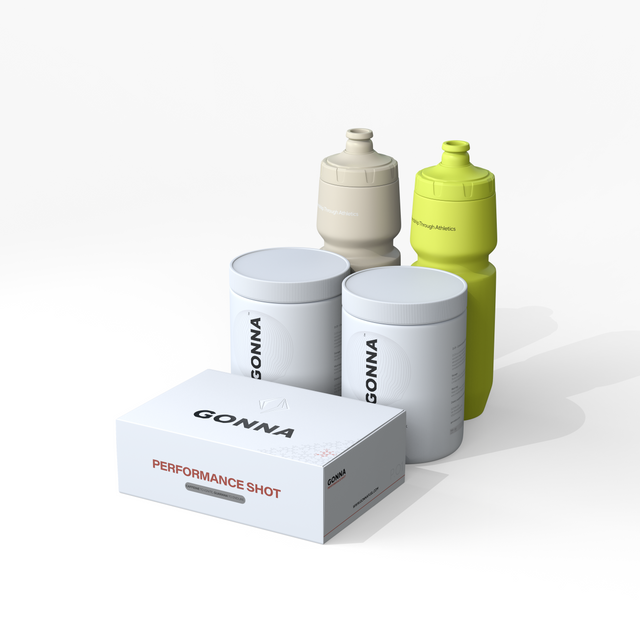
In GONNA terms, 90 g/h is roughly two C.O1 strips, or one strip alongside one and a half scoops of D.O1.
Not sure what your race needs? The calculator turns your event and duration into an hourly target and the number of strips or scoops that comes to.
Calculate my fuelDoes the format change absorption?
No. Pfeiffer and colleagues compared carbohydrate delivered as a gel, as a drink and as a solid across three hours of cycling and measured effectively identical oxidation rates. Format changes how easily you take it, not how well you absorb it.
Which matters more than it sounds, because compliance is where most fuelling plans fail. We wrote about that in more detail in does solid food absorb slower than a gel.
Tom
Sources
- Jeukendrup, A. (2008). Carbohydrate feeding during exercise. European Journal of Sport Science.
- O'Brien, W. & Rowlands, D. (2011). Fructose-maltodextrin ratio in a carbohydrate-electrolyte solution differentially affects exogenous carbohydrate oxidation rate, gut comfort and performance. AJP: Gastrointestinal and Liver Physiology.
- Podlogar, T. & Wallis, G. (2022). Increased exogenous but unaltered endogenous carbohydrate oxidation with combined fructose-maltodextrin ingested at 120 g/h versus 90 g/h. European Journal of Applied Physiology.
- Pfeiffer, B. et al. (2010). Oxidation of solid versus liquid carbohydrate sources during exercise. Medicine & Science in Sports & Exercise.